Good fit
- A named workflow owner and a measurable manual baseline
- Representative documents, plans, or cases that can be sanitized
- Outputs that a person can review before consequential action
Controlled AI Workflow Diagnostic
For technical teams evaluating AI-assisted document and plan workflows: map value, failure cases, permissions, human approvals, and recovery before committing to production integration.
Human-reviewed, fixed scope, and no obligation to continue into a pilot.
01 / Control before integration
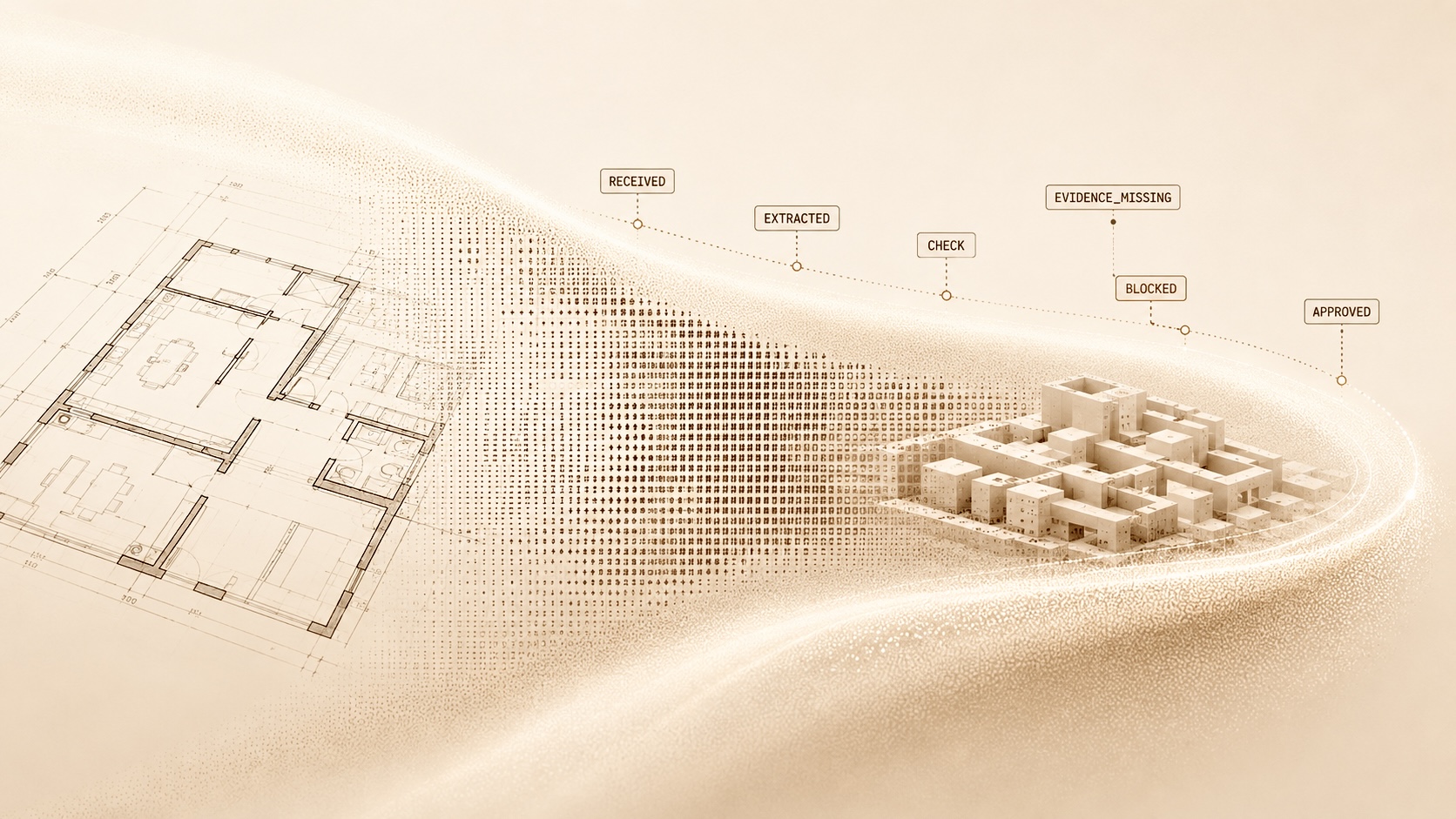
Evaluation covers the complete path from an incoming document to a reviewed decision—not the model in isolation. The diagnostic identifies what the model may propose, which checks must remain deterministic, and where a named person must approve or stop the process.
Input
Representative, sanitized documents and a defined operating boundary.
Model
Extraction, classification, uncertainty, and draft outputs.
Deterministic
Permissions, validation, states, retries, logs, and recovery paths.
Human
A named owner reviews consequential outputs before anything moves forward.
Failure path: stop, log the reason, route for review, and recover without hiding the exception.
02 / Diagnostic method
The engagement maps the real operating context, examines representative cases, and defines the smallest controlled next step worth considering.
Map
Document the owner, baseline, inputs, outputs, exceptions, systems, and consequential actions for one workflow.
Stress-test
Examine representative cases, known-bad inputs, uncertainty, permission denial, human escalation, and recovery paths.
Decide
Produce a go/no-go recommendation and, only when justified, the acceptance criteria and controls for a separately scoped pilot.
Bounded inputs
Up to three stakeholder interviews, up to three data or document categories, and approximately 5–10 sanitized examples supplied or validated by your team.
Decision pack
03 / Fit and boundaries
The diagnostic is designed to reduce uncertainty before a production build. It does not grant an AI system broad operational authority.
04 / Related delivery evidence
These portfolio case studies show the technical context behind the diagnostic. Each project page preserves its own scope, constraints, and reported outcomes.
AI system for technical and compliance verification on floorplans and large construction documents.
Read the AnalyzTech case studyPipeline that translates floorplan PDFs into an intuitive verification workflow for technical controllers, covering structural, PMR, and fire-safety checks.
Read the Floorplan Automation Pipeline case studyR&D project exploring practical techniques to detect and extract floorplan polygons with a reusable training and inference method.
Read the Floorplan Computer Vision case study05 / Detailed assessment
Share only non-confidential business context. No documents, production credentials, or sensitive architecture are required.
Your request is saved for human review. A booking link appears only after the intake endpoint confirms persistence.